
Inside the Money, Politics, and Manufactured Crisis at Piney Point
For over five years, the 676-acre Piney Point industrial site has been treated as a ticking ecological time bomb. Ever since a catastrophic liner tear in March 2021 forced the emergency dumping of 215 million gallons of toxic, nutrient-rich wastewater into Tampa Bay, public officials have operated under a permanent state of emergency.
An investigation combining newly captured aerial footage, public campaign finance disclosures, and recent local broadcasts reveals a stark disconnect between the physical reality on the ground and the high-pressure political maneuvering inside the Manatee County chambers.
While corporate executives and their legal counsel use the specter of an impending hurricane season to push through lucrative contract extensions, evidence shows the “emergency” is largely over. The heavy lifting of draining the toxic reservoirs is already done.
1. The Reality on the Ground: A Stabilized Site
During the June 16, 2026, Manatee County Board of County Commissioners (BOCC) meeting, the narrative pushed by corporate entities was one of imminent, storm-driven peril. Local media coverage and the site’s own leadership, however, had already begun painting a completely different picture.
Just days before the vote, on June 11, 2026, FOX 13 Tampa Bay reported that crews were officially “close to getting rid of all of the water, finally.” By the morning of the June 16 meeting, WFLA News Channel 8 was reporting that Herb Donica, the court-appointed receiver orchestrating the site’s permanent shutdown, explicitly stated he “hopes to finalize this project by the end of the year.”
Inside the commission chambers that same day, county staff delivered a presentation featuring visual evidence confirming that the massive gypsum stacks were already mostly empty. The physical reality on the screen completely undercut the high-stakes pressure to pass an emergency contract amendment. Chairman Tal Siddique openly acknowledged the milestone from the dais, stating bluntly that there was no longer an imminent threat because the lakes had been drained.
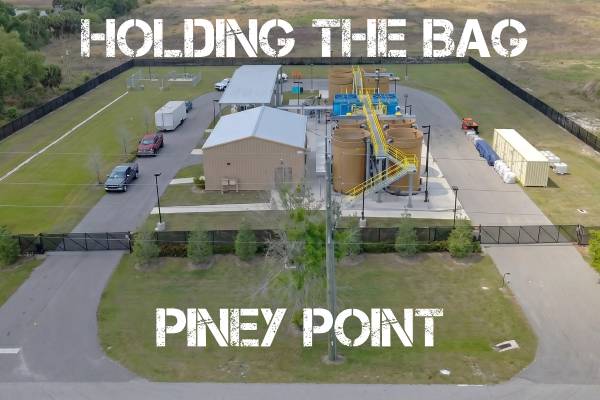
This dramatic stabilization is captured vividly in recent aerial footage:
The massive open-air reservoirs that once held hundreds of millions of gallons of volatile process water are gone. Instead of deep pools of toxic wastewater, there is only a shallow sheen of rainwater sitting on top of the synthetic material.
The Seepage Phase: Operations at the remaining stacks are transitioning into a slow ground-dewatering phase. The gypsum stacks act like massive sponges, absorbing contaminated water and bleeding it out slowly. Managing this “seepage phase” is actually more resource-intensive and expensive per gallon than pumping an open pond because the flow rate drops drastically while the infrastructure demands remain high. This raises a critical question for taxpayers. If the immediate threat of an open-reservoir breach has been neutralized, why is the county still absorbing massive operational costs from an outside vendor when the acute crisis has passed?
2. The Paper Trail: Letters, Leaks, and Dais Drama
To understand how the county committed to this stopgap contract, one must look at the dramatic shift between the board’s meetings in early and mid-June.
The June 2 Deadlock: “We’re Getting Screwed”
During the initial June 2, 2026, meeting, several commissioners balked at a long-term contract proposal, citing a lack of legal review, missing fee schedules, and the fundamental question of why local taxpayers were footing the bill for a state-regulated disaster.
The financial reality presented by the county’s Interim CFO was grim. The county had received $19.5 million in revenue from the site’s receivership but had spent $42.8 million on operations. This left Manatee County taxpayers absorbing a $23.4 million shortfall paid directly out of the General Fund, with no guarantee the state will ever reimburse them.

“We’re getting screwed,” Chairman Tal Siddique stated during the June 2 meeting, questioning why the state hadn’t delivered on previous funding promises. “I do not see treating Piney Point, or treating someone else’s environmental disaster, as a core function of our government… pulling $15.6 million from the general fund is not responsible.” Commissioner Bob McCann agreed, warning against writing a “blank check.” After deadlocking in a 3-3 tie, the board passed a second motion to table the contract until June 16, directing staff to return with additional documentation and seek state funding.
The June 16 Reversal: The Undisclosed Letter
By the time the board reconvened on June 16, the tone had shifted dramatically. Rather than waiting for staff to present their findings, Commissioner Rahn immediately moved to approve the amendment once it was read into the record. Watch the video below (which will start at 7:08:24).
The source of this urgency was revealed when Commissioner Bob McCann introduced a previously undisclosed letter from Bill Galvano, former President of the Florida Senate and powerhouse partner at the law firm Grimes Galvano, representing Chemical Injection Partners Solutions (CIP).
As McCann asked to enter the surprise document into the record, Commissioner Rahn visibly reacted, raising a hand in a questioning gesture and looking across the dais. Watch the video below (which will start at 7:19:42).
The June 15 letter, obtained by The Bradenton Times, reveals an intense legal and financial squeeze. Galvano warned that delaying the vote until late July would be “effectively a decision to terminate CIP Solutions’ operation and maintenance of the Deep Injection Well.” He argued that without a contract, reciprocal indemnification and insurance provisions would expire, placing both CIP and the county at massive legal risk.
An attached letter from Mark Stout, President of CIP, added further pressure. Stout revealed that CIP’s contract actually expired on May 27, 2026, and the company had been operating the well in “good faith.” He stated that a $1,296,446 change order for critical pretreatment facility repairs had been approved in April, and failing to pass the contract would jeopardize those repairs just as hurricane season approached.
Ironically, Stout’s letter requesting a rate adjustment confirmed that the crisis phase was over, noting the need to “account for the significant change in volume and flow rates resulting from the successful removal of water from the cells.”
The Manufactured Crisis and Alternative Options
Calling into the meeting, Commissioner McCann dissected the Galvano letter, categorizing it as a veiled threat that if CIP walked away, the county would have a major problem.
McCann expanded the scope of the debate, reminding the board of the Florida Department of Environmental Protection’s (FDEP) long history of regulatory negligence at the site. He pointed out that the facility had been operating without a valid permit for 20 years—with the original permit expiring in March 2001—and that the FDEP had ignored decades of warning signs.

McCann also debunked the idea that CIP was the only entity capable of managing the well. He noted that if CIP walked, the state would be forced to step in for emergency management anyway. Furthermore, specialized environmental contractors exist who are intimately familiar with the site’s water chemistry and infrastructure, such as Fortune LLC, along with a Fort Myers-based drilling and construction firm well-versed in the localized geology of these specific wells.
During public comment, district 4 candidate Glen Gibellina hammered the same point. “What skin in the game does CIP have? They have labor, that’s all they have,” Gibellina argued, pointing out that a 30-year county utilities employee had already confirmed the county could do the work in-house. “So please, you want to threaten to walk? Please take a hike, because nothing will change except the taxpayers will save a ton of money.”

Gibellina then pointedly addressed the political optics of the looming decision. “Quite frankly, some of you should recuse yourselves from this vote, ’cause I believe there are personnel from CIP that contribute to your campaigns,” he stated.
As Gibellina explicitly referenced the vendor’s campaign contributions, chamber footage appears to show Commissioner Rahn smiling and laugh from the dais.
Despite these arguments, Siddique flipped his previous vote, joining Commissioners Rahn, Amanda Ballard, and George Kruse to pass the amended contract 4-1.
3. Following the Money: The Campaign Finance Connections
Public campaign finance records show a series of contributions made to the re-election campaigns of commissioners who ultimately supported the contract. These donations occurred in the weeks leading up to the critical votes.

To understand the weight of these contributions, it is important to note the current political landscape on the dais. Commissioners Mike Rahn and Amanda Ballard are both actively seeking re-election in 2026. Conversely, Commissioners George Kruse, Bob McCann, and Chairman Tal Siddique are not up for re-election this cycle, as their terms run through 2028. Furthermore, Commissioner Jason Bearden is not seeking another term.

| Date | Donor | Connection to Project | Recipient | Amount |
| April 20, 2026 | Mark Stout | President of CIP (based on public records) | Commissioner Amanda Ballard | $1,000 (Max Legal) |
| May 12, 2026 | Grimes Galvano, PL | Law firm representing CIP | Commissioner Mike Rahn | $1,000 (Max Legal) |
The Revolving Door

The career trajectory of Courtney De Pol highlights what critics often point to as a political revolving door. Hired in January 2022 as Director of Development Services under former Administrator Scott Hopes, De Pol was promoted to Deputy County Administrator later that same year, overseeing critical infrastructure wings including Public Safety, Development Services, and Human Resources.
Her final day managing county operations was April 3, 2026. Less than two months later, De Pol crossed the aisle from public oversight to corporate payroll, taking an executive role as Chief Revenue Officer for Chemical Injection Partners (CIP)—the vendor running the deep injection well to dispose of the Piney Point wastewater.
On May 13, 2026, two separate $250 campaign contributions were made—one to Commissioner Rahn and one to Commissioner Ballard—by a donor listed in public records as Courtney De Pol. While the donor’s address is exempt from disclosure under public records privacy laws, the name matches that of the former Deputy County Administrator.
Shortly after this financial timeline and De Pol’s executive hiring, CIP was actively vying for its contract renewal before the board.
4. The Deep-Well Gamble: Trading a Surface Crisis for a Subsurface Risk
While the political class coordinates contract extensions, environmental watchdogs, including ManaSota-88, Suncoast Waterkeeper, and the Center for Biological Diversity, warn that the county is trading a short-term surface crisis for permanent groundwater destruction.
CIP’s primary objective is pumping the extracted Piney Point wastewater thousands of feet underground into a deep injection well. Environmental groups have fiercely protested and sued over this method, arguing that injecting hundreds of millions of gallons of nutrient-dense, chemically altered wastewater into the earth risks permanently contaminating the Floridan Aquifer, the primary source of the region’s drinking water and agricultural irrigation.
The Pre-Treatment Myth: Environmentalists point out that the “pre-treatment” administered to Piney Point wastewater is designed primarily to ensure it does not clog or corrode the injection well machinery. It does not completely eliminate heavy metals or potential radioactive elements.
5. Six Decades of Malpractice: How We Got Here
The rush to hand out lucrative vendor contracts is only the latest chapter in a 60-year legacy of industrial mismanagement, corporate bankruptcies, and state regulatory failures at Piney Point.
The Timeline of a Sinking Ship

- 1966: The facility is built by the Borden Chemical Company to process phosphate rock into fertilizer, creating massive phosphogypsum waste stacks.
- 1970s: Severe pollution and wastewater dumps into nearby Bishop Harbor decimate local marine life, sparking the site’s first major fish kills.
- 1980s to 1990s: The site repeatedly changes hands. Toxic gases are released into the air, and a sulfuric acid leak triggers local evacuations. The Mulberry Corporation takes over but faces immediate financial ruin while leaking ponds contaminate local underground water.
- 2001: Mulberry Corporation files for bankruptcy and completely abandons the site with just 48 hours’ notice. The FDEP and EPA step in. Hurricane Gabrielle causes the abandoned ponds to overflow, forcing more emergency dumps into Bishop Harbor.
- 2006: HRK Holdings buys the property out of receivership for $4.3 million to store marine dredge material, despite a 2008 U.S. Army Corps of Engineers study explicitly warning that doing so could cause a catastrophic breach in the liner.
- 2011: The Army Corps’ warning comes true. A massive leak caused by the dredging project forces an emergency discharge of millions of gallons of wastewater into Tampa Bay.
- March 2021: The ultimate failure occurs. A massive tear in the containment wall liner threatens a 20-foot wall of toxic sludge. Over 300 homes and local businesses are evacuated as a state of emergency is declared, and 215 million gallons of untreated, acidic wastewater are pumped directly into Tampa Bay to prevent a total collapse.

The Million-Dollar Question
Following the 2021 disaster, the state stripped HRK Holdings of control and appointed a receiver to dismantle the facility. While the FDEP successfully secured a $258.1 million final default judgment against HRK Holdings in August 2024, collecting those funds remains an uphill battle.
Today, Manatee County taxpayers are left holding the bag for a crisis that has technically moved past its acute phase. The massive surface lakes of contaminated wastewater are gone, and the site is structurally stabilized. However, the remaining gypsum stacks continue to act like massive, slow-draining sponges. FDEP is currently overseeing the final closure design, yet the contract itself explicitly defines a “Long Term Seepage Phase” targeting a flow rate of 0.19 MGD, or 190,000 gallons per day. To put that in perspective, even during this “quiet” phase, the volume of roughly 10 to 12 average backyard swimming pools of wastewater will continue to be pumped underground every single day, diminishing slowly over the next 48 years.
The site’s true lifespan is just beginning, requiring a half-century of post-closure monitoring. The immediate emergency has passed, yet a majority of the Manatee County Commission have chosen to keep writing blank checks for extended private vendor contracts. Perhaps, at Piney Point, the flow of political capital is just as hard to contain as the wastewater once was.

